Karnataka is about to formalise the biggest structural change to its public school stock in a decade. Chief Minister Siddaramaiah chaired a department review on May 19 and confirmed the Karnataka Public School (KPS) scheme will be launched on June 1 in Shivamogga, with the inaugural event at Allama Prabhu Grounds. Foundation stones for nearly 1,000 KPS campuses are to be laid the same day, with a stated target of 800 fully operational KPS schools within two years.
This brief is for the school administrators — block education officers, BRC coordinators, principals of state and aided schools in Karnataka, and academic leads at affiliated private institutions — who will live with this scheme from June 2 onwards. The headline numbers are large. The operational implications, less obvious, are what will decide whether June 1 is a launch or a launch ceremony.
What a KPS campus actually is
Each Karnataka Public School is designed as a single physical campus housing 1,200 students from LKG to Pre-University Course (Class 12), in both Kannada and English mediums. That is a long vertical — 14 grades on one site — and a deliberate departure from the typical Karnataka model where lower primary, upper primary, secondary and PUC sit in three or four different institutions, often with different headmasters and disjointed records.
The vertical-stack design is the substantive bet. It collapses three transition points (Class 5 to 6, Class 7 to 8, Class 10 to 11) into a single institutional record, which the department hopes will cut the transition-stage drop-out spike that the most recent National Achievement Survey numbers flagged for Karnataka. For school heads, it means the student you admit at LKG is the student you graduate at PUC II — and the school records, parent-teacher relationships, and remedial trajectories follow that child for 14 years.
The June 1 calendar — what is actually starting
The CM's directive is to begin the tender process immediately and set up 800 KPS schools this year, with the remaining 200 in 2027-28. June 1 is therefore a launch of the scheme, not the opening of 800 new schools.
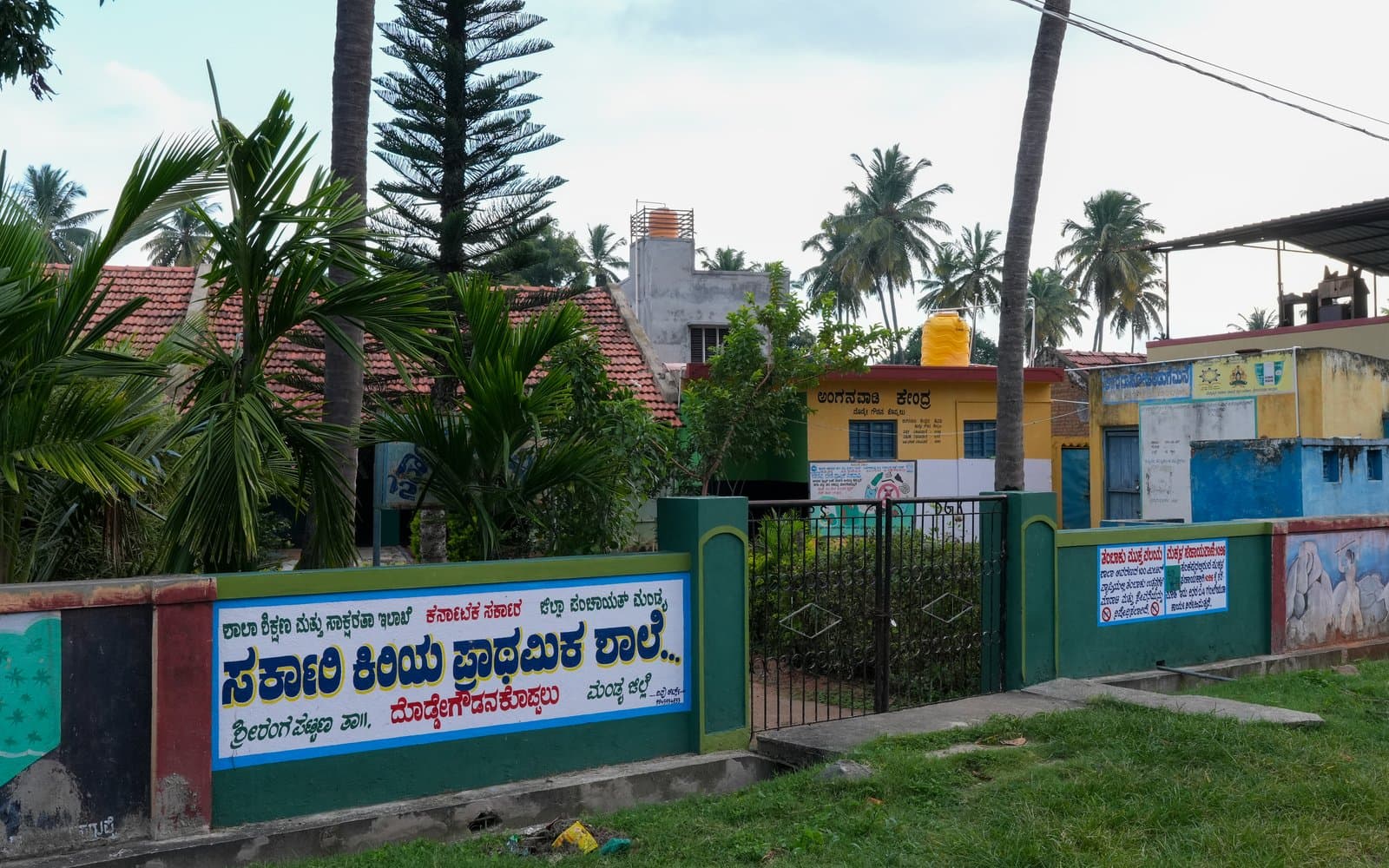
What actually starts on June 1 in most blocks is conversion, not new construction. KPS schools are being formed by amalgamating existing state government schools (lower primary, higher primary, high school, and PU College within a five-kilometre radius) into a single administrative unit and physical campus where possible. The block education officer's first task in June and July is to identify the parent campus, the joining campuses, and the staff redeployment plan.
The CM also directed officials to examine school bus facilities for KPS schools and submit proposals to the Finance Department for filling teacher vacancies. Both are open items as of the launch date — neither the bus contract design nor the recruitment notification has been issued, and administrators should not assume either is in place when the June 1 banner goes up.
The dual-medium requirement
The scheme commits each KPS campus to offering both Kannada and English mediums. For a single 1,200-student campus, that is two parallel sections per grade at minimum and four to six sections at scale. Two operational consequences follow.
First, the staffing math doubles for some subjects. A KPS that runs three Class 8 sections in Kannada and three in English needs Mathematics and Science teachers competent in both mediums, or two distinct teacher pools. The current SSLC and PUC teacher allocation models do not account for this split. Block officers should plan for either bridge training of existing Kannada-medium teachers or a fresh English-medium hiring round — the proposal to the Finance Department is the formal channel.
Second, the textbook and TLM (teaching-learning material) procurement runs through two parallel chains. Karnataka Textbook Society inventories for Kannada are well-mapped; English-medium TLM for state-board grades is thinner. The CM also reviewed a proposal to distribute free notebooks along with free textbooks — administrators should factor in that the textbook supply chain for English-medium intake will be the binding constraint, not Kannada.
What the May 2026 result table actually says
The CM's review also surfaced examination performance data that frames the KPS investment. SSLC pass percentage stood at 94.10% in 2026, a 14.06-point improvement over the prior year. PUC results rose to 86.48% from 73.45%. A total of 2,393 SSLC schools recorded 100% results, up from 766 the prior year. Rural students outperformed urban students in both SSLC and Second PUC.
For administrators evaluating their school against state benchmarks, two numbers matter more than the headline. SC and ST student pass rates rose 18 points; Category 2B rose 18 points; Kalyana Karnataka, the historically under-served region, improved by 2 points. The KPS scheme is, in effect, betting that the institutional gains visible in this year's results can be locked in by giving these cohorts a single, continuous school home from LKG through PUC. The implementation test is whether the per-campus 1,200-student cap creates real teacher-to-student ratios in those categories or whether the cap becomes a constraint.
The four operational questions every KPS principal will face
From the limited rollout documentation available, these are the questions principals and block coordinators will need to answer in the next eight weeks.
First, the records-consolidation problem. When three schools merge into one KPS, the student records — admission registers, scholarship rolls, mid-day meal counts, RTE-25% reservation rosters — need to merge under one academic record number. The state's UDISE+ data infrastructure can handle this, but only if the consolidating headmasters coordinate before the new academic session starts. Block officers should set a June 15 deadline for the consolidated UDISE+ submission.
Second, the parent-communication problem. Parents of children at the joining campuses may not understand that their school is becoming part of a larger institution. Loss-of-identity concerns are real, particularly at primary schools that have served a village for decades. Each KPS will need a printed parent letter — bilingual, signed by the new principal and the block education officer — that names the parent campus, the joining campuses, and the date of formal merger.
Third, the RTE-25% transition. Karnataka's private unaided schools enrol RTE quota students annually. The KPS conversion does not directly touch private schools, but in geographies where a private school's RTE intake was historically backstopped by a nearby government primary, the geography of "neighbourhood school" changes. Administrators should expect parent queries about whether RTE seats are now to be claimed at the KPS instead.
Fourth, the PU College integration. KPS aims to extend through PUC, which means a chunk of the existing 1,200-student campus is grade 11 and 12, with PU faculty rules, PU lab requirements, and PU university affiliations. The administrative folding of PU into the school education department is operationally complex — a separate exercise from converting government schools into KPS. Principals should treat PU integration as a Phase 2 task, not a Day-1 task.
What June through August looks like
Karnataka schools reopen on May 29 for the 2026-27 academic year. June 1 then lands inside the first working week of the new session, which is intentional. Administrators should expect three rapid-fire operational layers between now and end-August: the launch (June 1), the tender and recruitment process for the first 800 campuses (June through August), and the consolidated UDISE+ census (typically September). Anything that does not get logged in UDISE+ at the September submission will not be funded under the new scheme.
The KPS scheme is structurally the most ambitious public school reform Karnataka has attempted since the Sarva Shiksha Abhiyan rollout. The June 1 launch is the easy part. The hard part is the next 700 days — and the principal in the parent campus is the one running it.